
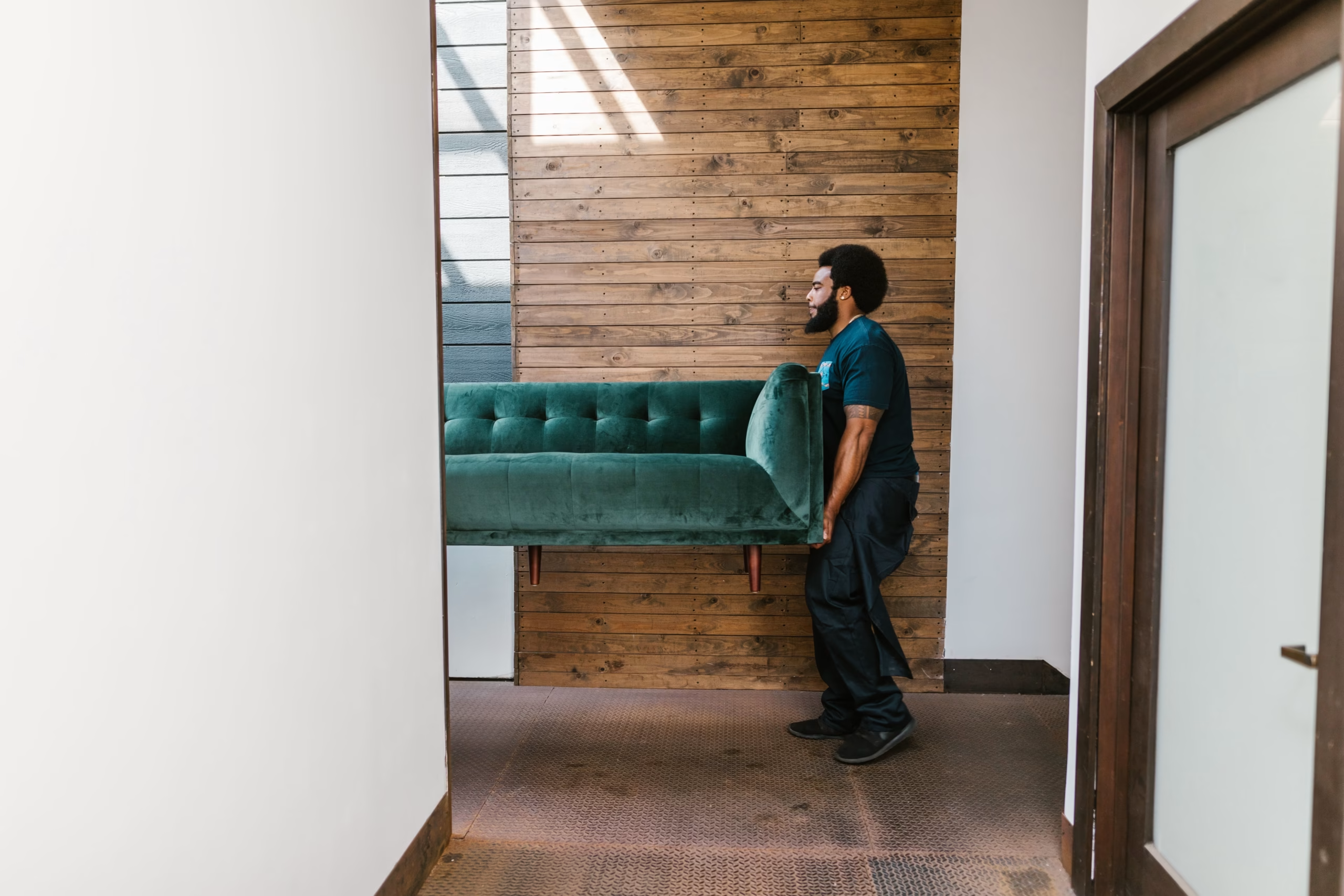
Getting a beautiful, heavy sofa delivered to your apartment or new home is a great feeling—until you realize it is two inches wider than your front door. Forcing a bulky piece of furniture through a tight hallway by sheer physical strength is a guaranteed way to rip expensive upholstery, permanently scrape your landlord’s doorframes, and severely strain your lower back.
You do not need to return the sofa or pay a premium for a specialized moving crew just yet. Moving oversized furniture through undersized architecture is a puzzle of geometry, not just a test of brute strength. By understanding how to manipulate a sofa’s diagonal depth, stripping the frame down to its core, and executing professional maneuvering techniques, you can safely guide almost any heavy couch through the tightest corridors.
We are breaking down the mathematical tricks, the essential preparation steps, and the four professional maneuvers used by relocation experts to conquer narrow doorways without leaving a single scratch on your walls.
The Mathematical Reality: Measure Twice, Lift Once
The biggest mistake people make is comparing the sheer width of the sofa to the sheer width of the door. Couches are not perfect rectangles; their arms, backrests, and seats create an irregular cross-section.
Before you attempt to lift the furniture, grab a tape measure and document these four dimensions:
- Doorway Width and Height: Measure the exact clearance of the door. Check the angles behind the door as well, ensuring there is enough room in the corridor to turn once you pass the threshold.
- Sofa Width and Height: Measure the absolute longest and tallest points of the couch.
- Sofa Depth: Measure from the front edge of the seat to the furthest point of the backrest.
- Diagonal Depth (The Secret Weapon): Measure from the bottom-front edge of the sofa’s frame to the top-back edge of the headrest.
When you tilt a sofa onto its side, the relevant clearance dimension changes from the standard depth to the diagonal depth. In many cases, the diagonal depth is significantly smaller than the standard height or width, meaning a couch that looks too large to fit straight on will easily slide through when angled correctly.
The Essential Preparation Sequence
Never try to carry a fully assembled sofa through a tight space. Stripping the couch down and preparing the environment is mandatory to prevent getting physically wedged in a doorframe.
1.Strip the Sofa:Reduces overall dimensions by up to 6 inches.
Remove all loose seat cushions, pillows, and slipcovers. The most critical step is unscrewing the legs and feet. Most couch legs add 4 to 6 inches to the overall height and create awkward protrusions that snag on doorframes. If your sofa has a reclining mechanism or detachable armrests, unbolt them and place all hardware in a labeled Ziploc bag.
2.Remove the Door from its Hinges:Requires a hammer and flathead screwdriver.
Even when fully open, a standard interior door reduces the size of your entryway by about 1.25 inches. Place a nail or flathead screwdriver against the bottom of the door’s hinge pin and tap it gently upwards with a hammer until it slides out. Lift the door off the hinges and set it aside to maximize your clearance.
3.Wrap and Bind:Failing to do this risks permanent upholstery damage.
Wrap the entire sofa in heavy padded moving blankets to protect it from nicks, dents, and scratches. Once covered, wrap the blankets tightly with 2 to 3 layers of industrial plastic stretch wrap to hold the padding in place. Tape down any loose fabric edges so they do not catch on splinters.
4.Clear and Protect the Pathway:
Remove floor rugs, hallway tables, and wall picture frames from your route to eliminate tripping hazards. Tape thick cardboard or spare towels around the edges of the doorframe to act as cheap insurance against scuffed paint.
The 4 Master Maneuvering Techniques
Once your sofa is stripped, padded, and measured, you and your moving partner must execute one of these four professional maneuvers. Communication is critical: assign one person to lead the direction and one to follow, ensuring no one lifts before the other is ready.
1. The Classic Tilt (The 45-Degree Angle)
This is the most common solution for a standard tight fit. Stand the sofa up and tilt it forward at a 45-degree angle so it resembles a diamond shape approaching the door. Because you are relying on the diagonal depth rather than the flat base width, the narrowest profile of the sofa passes through the doorframe first.
2. The Pivot-and-Slide (The Vertical Stand)
This technique is required when a couch fits through a doorway vertically but the hallway is too narrow to carry it horizontally.
- Stand the couch on one end so it is perfectly vertical.
- Slide the bottom end through the doorway first.
- Once the bottom clears the frame, pivot the couch around the door jamb in a semi-circle, guiding the top half through while rotating.
3. The Hook (The “L” Method)
If your sofa has massively oversized, fixed arms, or if you are moving an L-shaped sectional piece, you will need to “hook” it. Approach the door with the sofa angled like an “L”. Walk the leading arm of the sofa through the doorway first, hooking it around the door jamb. Once the first arm is safely inside the room, rotate the back of the sofa through the opening, followed finally by the second arm.
4. The Squeeze (For Soft Furniture Only)
If you are moving a heavily stuffed, plush sofa and you are only missing a fraction of an inch of clearance, you can rely on soft tissue compression. Since the structural wood frame is usually much smaller than the outer foam padding, you can aggressively compress the padded arms through the doorframe. This only works if you have wrapped the sofa tightly in moving blankets; otherwise, the friction will rip the bare upholstery instantly.
Equipment That Saves Your Back (and Walls)
Relying purely on raw physical strength is dangerous. Utilizing the right household moving equipment dramatically reduces the physical strain of maneuvering heavy furniture through tight spaces.
| Equipment | What It Does | Best Use Case |
| Furniture Sliders | Small plastic or felt pads placed under the corners of the sofa to eliminate floor friction. | Gliding a heavy sofa down a long, narrow hallway without scratching the floorboards. |
| Four-Wheel Dolly | A flat wooden platform on caster wheels. | Rolling a vertically standing sofa to the doorway before initiating the pivot-and-slide maneuver. |
| Lifting Straps (Forearm Forklifts) | Heavy-duty nylon straps worn over the forearms or shoulders to distribute weight evenly. | Carrying a heavy sofa up a flight of stairs or over an uneven doorway threshold, reducing direct back strain. |
| Quilted Moving Blankets | Thick fabric pads that absorb physical shock. | Preventing deep gouges in drywall and protecting the sofa’s wooden frame. |
What to Do When It Truly Won’t Fit
Sometimes the math simply does not work. If your couch is 40 inches deep and your only doorway is 28 inches wide, no amount of tilting or door removal will solve the physics. Before you panic or damage your property by forcing it, consider these alternatives:
- Check Alternative Entries: Look for a sliding glass patio door (which typically offers 30 to 36 inches of clearance), a large ground-floor window, or a wider garage entry door.
- Hire Professional Disassemblers: Certain moving companies and specialized furniture technicians can surgically cut the internal upholstery staples, completely dismantle the wooden frame of the couch, carry it inside in pieces, and professionally rebuild and restaple it in your living room.
- Balcony Hoisting: If you live on the second or third floor, professional movers can frequently hoist the sofa over the balcony using specialized rigging and heavy-duty straps.
Frequently Asked Questions (FAQ)
Can I pull a heavy sofa using furniture sliders?
No. When using furniture sliders, you must always push the furniture. If you attempt to pull a heavy sofa, the friction between the furniture and the floor increases, the sliders will slip out from underneath the legs, and the sofa will drop abruptly onto the floor.
Is it safe for two people to move a heavy sleeper sofa?
Sleeper sofas contain heavy internal metal mechanisms and often require three or four people to move safely. If you must move a sleeper sofa, always use heavy-duty zip ties to lock the metal bed frame closed before lifting; otherwise, the bed can spring open mid-lift and cause severe injury.
Should I wear gloves when moving a sofa?
Yes. High-grip work gloves prevent your hands from slipping off the slick plastic stretch wrap, and they protect your knuckles from getting crushed between the sofa frame and the narrow door jambs.
Even the most intimidating, oversized sofas can be coaxed through narrow residential doors with the right strategy. By removing the door hinges, unbolting the sofa legs, and wrapping the furniture in protective blankets, you eliminate the friction that causes property damage. Take your time, communicate clearly with your moving partner, and rely on the diagonal tilt or pivot-and-slide maneuvers to conquer the tightest corners with total confidence.